ADVENT BIBLE STUDY
Lessons are available here, and are held each Sunday mornings from 9:00 – 9:50 on November 30, December 7, December 14, and December 21. Lesson download available. (Please try to login before 9 a.m. If you login after 9 a.m., say your name in a low voice. No greeting is needed. Contact Cheryl Bassett for help with login.
EDUCATION
SAINT ANDREWS UMC FTW
12/7/202517 min read
Study & Zoom Info Below . . .
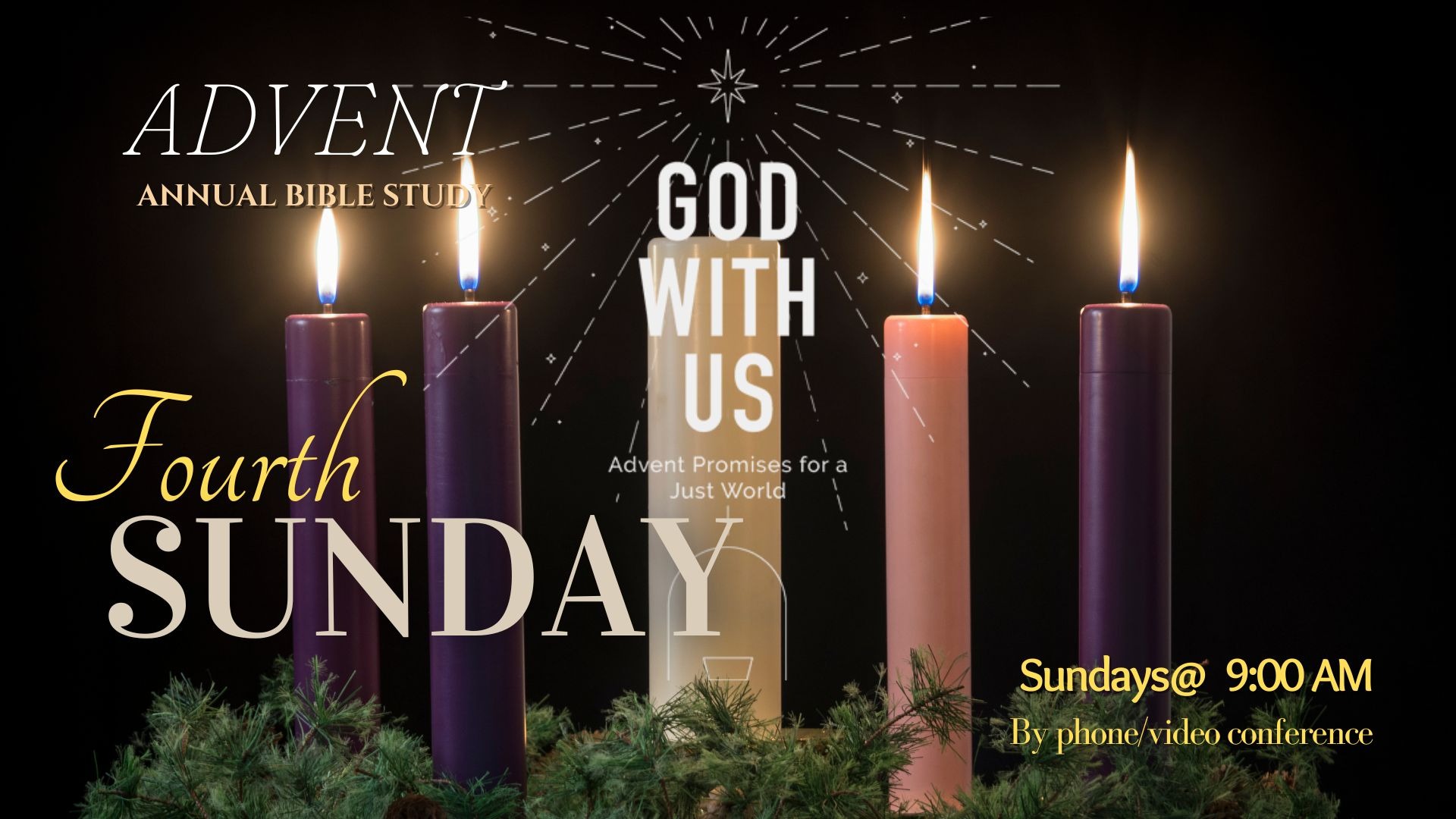
WELCOME TO ADVENT 2025
“GOD WITH US”
The Promises of Hope, Peace, Joy, and Love for a Just World
RELIGION AND RACE
The United Methodist Church
(Very important information for you to read for the Advent Study)
Saint Andrews United Methodist Church Education Ministry
Via Zoom and/or Telephone Communication:
https://zoom.us/j/97668922519?pwd=TVVnbTBxS1hZYVBIN00xUXlqMnk0dz09
Zoom: ID – 953 4026 5377 Passcode: 458 666
Telephone Conference: 346-248-7799.
Study & Zoom Info Below . . .
Saint Andrews UMC 1 is inviting you to a scheduled Zoom meeting.
Topic: Churchwide Advent Study
Time: This is a recurring meeting Meet anytime
Join Zoom Meeting
https://zoom.us/j/97668922519?pwd=TVVnbTBxS1hZYVBIN00xUXlqMnk0dz09
Meeting ID: 976 6892 2519
Passcode: 275853
---
One tap mobile
+13462487799,,97668922519#,,,,*275853# US (Houston)
+12532158782,,97668922519#,,,,*275853# US (Tacoma)
---
Join by SIP
Passcode: 275853
Join instructions
You may begin signing in at 8:30 a.m.
Please make every effort to sign in before 9:00 a.m., as we begin the lessons at 9:00 a.m.
You may join the Lenten Bible Study by Zoom or telephone conference:
To join by Zoom: Click on this link:
https://zoom.us/j/97668922519?pwd=TVVnbTBxS1hZYVBIN00xUXlqMnk0dz09
or input the following to dial in here:
Enter on keypad: 1-346-248-7799
Enter Meeting ID: 953 4026 5377 #
Enter: # Enter Passcode: 458666 #
To join by telephone conference, input and follow the instructions:
(It is easier to follow the instructions if you place your telephone on speaker so you will be able to hear the instructions.)
(If you sign in after 9 a.m., please state your name in a low voice—no other conversation is necessary.
Please study the information in your packet for each Sunday and bring the packet with you to the class.
We hope you will participate in the study each Sunday by sharing your ideas, participating in the discussions, and asking questions.
Blessings to each of you for your participation. Thanks for joining our study.
SAUMC Education Ministry
Advent is a season of waiting, longing, and preparation. It is also a season
when God’s promises break through the shadows of injustice with the light of hope, peace, joy, and love. This study discusses promises for a just World not only to the coming of Christ into the world, but also to the ways Christ calls us to enact justice, equity, and belonging in our communities.
Our world is fractured by division, polarization, and systemic inequities that deny the fullness of God’s image in every person. Yet, Advent insists that God is with us—in exile and homecoming, in despair and restoration, in conflict and reconciliation.
This study pairs the traditional Advent themes with the core commitments of racial justice, intercultural competency, and equity. The purpose is twofold:
• To nurture a deeper hope in Emmanuel, God with us, who meets us in our longings and renews our strength.
• To call congregations to live faithfully by aligning discipleship with God’s justice, practicing equity, and creating spaces where all can belong.
Lessons are held each Sunday morning from 9:00 – 9:50 on November 30, December 7, December 14, and December 21.
Please try to login before 9 a.m. If you login after 9 a.m., say your name in a low voice. No greeting is needed.
Contact Cheryl Bassett for help with login at 972-655-8388.
For help with getting a packet, contact Daisy DuBose at 817-366-9201.
Daisy DuBose
FIRST SUNDAY OF ADVENT: November 30th, 2025
THE PROMISE OF HOPE
OPENING PRAYER
God of Hope,
In a world that often feels broken, silent, or unjust,
we turn to you with expectation.
Let your Word stir in us a new imagination.
May your promises be the foundation of our hope,
not just for ourselves, but for our communities and all creation. Amen.
SCRIPTURE
Jeremiah 33:14-16 (New Revised Standard Version (NRSV)
A righteous branch springs from David.
The days are surely coming, says the LORD, when I will fulfill the promise
I made to the house of Israel and the house of Judah.
In those days and at that time I will cause a righteous Branch to spring
up for David, and he shall execute justice and righteousness in the land.
In those days Judah will be saved, and Jerusalem will live in safety. And
this is the name by which it will be called: “The LORD is our righteousness.”
The words of hope in Jeremiah 33:14–16 come not from a place of triumph but from the heart of catastrophe. To better understand today’s text, we need to understand the prior verses. Jeremiah is under arrest (Jer. 33:1), accused of demoralizing the people by proclaiming divine judgment. The Babylonian Empire is advancing, and Jerusalem faces imminent destruction. The city is gripped by fear, and its streets are already filled with death and despair (33:4–5). The once-proud kingdom of Judah is collapsing politically, spiritually, and socially. It is in this moment of trauma, devastation, and exile that God speaks a promise.
Jeremiah has just done something radical. He purchased land in a country that is about to fall. A foolish investment in earthly terms, but a prophetic declaration of faith in God’s future. Now, still locked up, Jeremiah proclaims a new promise: that a righteous Branch will spring forth from David’s line. This image echoes Isaiah’s vision of new life from a dead stump—a sign that even in despair, God is still at work, quietly bringing forth justice and renewal.
To a people who had lost everything—land, temple, kingship, and national identity—Jeremiah’s words offer audacious hope. The Davidic monarchy may be gone, but God is not. The covenant remains. Exile is not the final word. Death is not the end. A Branch will grow. This is not naïve or sentimental hope. Jeremiah knows pain. He has spoken judgment. He is in chains. But it is precisely because he has looked despair in the eye that his words of hope carry such weight. The promise of restoration is not wishful thinking—it is God’s faithfulness pushing back against fear.
This is the hope of Advent: a promise spoken in the darkness. It doesn’t ignore the pain of exile, injustice, or grief. It declares that even in these places, God is present—and God is not finished. The righteous Branch we await, now revealed in Jesus, is the one who brings righteousness and justice not just to Israel but to the entire world.
The hope we proclaim is not just for individuals but for communities. It is not just comfort—it is transformation. The Branch that Jeremiah announces, the Messiah we await, is one who brings justice and righteousness to the land. Not only for Jerusalem and Judah, but for the world.
Today, we too live in a kind of exile—longing for justice, burdened by division, injustice, and uncertainty. Like Jeremiah’s people, we are waiting. But Advent tells us this waiting is not empty. It is pregnant with promise. Our hope is not based on circumstances, but on the character of a God who keeps promises—even in the rubble.
In your congregation, people may feel trapped—by grief, loss, financial insecurity, or to be facing Babylonian armies, but they know what it is to feel under siege. In this season, Jeremiah’s word is ours: A righteous Branch will spring up. Even now, especially now. God’s justice is coming.
COMMENTARY & REFLECTION
1. Jeremiah proclaimed hope while imprisoned, and while his people were under threat. What does it mean to proclaim hope today when systems of oppression, racism, and exclusion still persist?
2. Jeremiah’s purchase of land was a prophetic act—a tangible sign of hope. What are some bold acts of hope that individuals or churches can take today to affirm that justice and restoration are coming? What does hope look like when justice seems delayed or denied?
3. The “righteous Branch” is promised to bring justice and righteousness to the land. How do we understand God’s justice today in light of racial injustice, migration struggles, and economic inequality?
4. Advent hope is not passive optimism—it’s an active expectation rooted in God’s faithfulness. How can your community actively hope and work for a future grounded in equity, dignity, and belonging?
COMMUNITY DISCUSSION QUESTIONS
CLOSING PRAYER: (UNISON)
God of promise and persistence,
You speak hope in the darkest places.
You plant seeds of justice in scorched earth.
As we leave this time of reflection,
Let us carry your promise with courage—
That we may wait not passively,
But live as people of active, disruptive hope.
A righteous Branch will spring up. Thanks be to God. Amen.
SECOND SUNDAY OF ADVENT: December 7
THE PROMISE OF PEACE
OPENING PRAYER
God of Peace,
in a world filled with disruption and division,
help us to hear John’s cry—not as noise,
but as necessary preparation for healing.
Give us the courage to walk the rough terrain of truth-telling, and
the grace to be peacemakers in our communities. Amen.
SCRIPTURE
Luke 3:1–6 (New Revised Standard Version (NRSV)
In the fifteenth year of the reign of Emperor Tiberius, when Pontius Pilate
was governor of Judea, and Herod was ruler of Galilee… during the high
priesthood of Annas and Caiaphas, the word of God came to John, son of
Zechariah, in the wilderness. He went into all the region around the Jordan, proclaim
ing a baptism of repentance for the forgiveness of sins, as it is
written in the book of the words of the prophet Isaiah: “The voice of one
crying out in the wilderness: ‘Prepare the way of the Lord, make his paths
straight. Every valley shall be filled, and every mountain and hill shall be
made low, and the crooked shall be made straight, and the rough ways
made smooth; and all flesh shall see the salvation of God.’”
The second Sunday of Advent invites us into a deep longing: the longing for peace - not just for the absence of conflict, but for the presence of justice, reconciliation, and right relationship. In the Gospel reading, peace does not arrive gently—it breaks into the world through a fiery wilderness preacher named John.
Luke opens this passage not with gentle images of serenity, but with a litany of political and religious rulers—Tiberius, Pilate, Herod, Annas, Caiaphas— reminding us of the imperial power and religious compromise of the time. John’s call to repentance and renewal enters precisely this landscape of power and brokenness. It is no accident that the word of God does not come to any of them. It comes to John, alone in the wilderness. That is a radical declaration: God’s peace begins on the margins. John’s message, quoting the prophet Isaiah, is not about surface-level change:
“Prepare the way of the Lord... Every valley shall be filled, every mountain and hill made low… and all flesh shall see the salvation of God.”
This is not poetic landscaping—it’s a blueprint for justice. The valleys and hills represent societal inequities. The crooked paths are systems distorted by greed, power, or exclusion. For the Prince of Peace to arrive, the people must first engage in the work of metanoia—repentance that changes hearts, habits, and public structures. Peace, in John’s proclamation, is not a soft sentiment. It’s a radical reordering of the world. John’s baptism of repentance is not about individual purity alone. It is a call to public accountability. It is not a performance of piety; it is preparation for transformation. Peace, in John’s vision, is not passive—it is participatory. It asks us to tell the truth, to do repair, and to make way for the arrival of God’s justice.
Even the Jordan River setting is symbolic. This is the boundary the Israelites crossed into the Promised Land. By baptizing there, John proclaims that God is once again forming a people—not based on empire or ethnicity, but on readiness to welcome the Messiah through humility justice, and communal transformation.
The scripture reminds us that the pathway to peace requires excavation. It demands that we tear down the mountains of supremacy, fill in the valleys of neglect, and smooth the rough terrain of division and despair. The peace Christ brings is not easy or polite—it is liberating. It releases captives, restores dignity, and realigns creation with God’s justice.
In this season, we are not simply waiting for Christ to come. We are clearing the way In our lives, in our communities, and in our institutions, we are called to be road builders for God’s peace. That means:
• Telling the truth about harm done,
• Engaging in repair and real repentance,
• Creating communities where forgiveness is not a transaction, but a way of life.
This kind of peace is not comfort—it is disruption for the sake of restoration. Like John, we are called to prepare the way—not through perfection, but through participation in God’s vision of peace on earth.
COMMENTARY & REFLECTION
1. John the Baptist’s call to “prepare the way” included leveling the land. What are the “mountains” of privilege or “valleys” of exclusion that still block the path to peace in your church or community?
2. Peace in this text involves repentance and transformation. What systems or attitudes in your congregation or neighborhood must be confronted or reshaped for true peace to take root?
3. John’s call to repentance invited people to change both inwardly and outwardly. What might “fruit worthy of repentance” look like in your justice work or relationships with marginalized communities?
4. Luke’s Gospel insists that “all flesh shall see the salvation of God.” How can your church or small group embody a peace that includes those historically excluded—immigrants, LGBTQ+ persons, disabled people, or those experiencing poverty?
5. What would it look like for your community to be “road builders for peace”? What concrete steps can you take—individually or collectively—to make space for God’s liberating peace?
COMMUNITY DISCUSSION QUESTIONS
CLOSING PRAYER: (UNISON)
God of the Wilderness,
Help us prepare—not with fear,
but with truth, courage, and repair.
As we make room for you,
make room in us for justice and peace. Amen.
THIRD SUNDAY OF ADVENT: December 14
THE PROMISE OF JOY
OPENING PRAYER
God of Joy,
You sing over your people with delight.
Let your song rise in us today - especially for those who are
weary, grieving, or afraid.
Remind us that joy is not just for the strong, but for the struggling, the
faithful, and the hopeful. Amen.
SCRIPTURE
Zephaniah 3:14–20 (New Revised Standard Version)
Sing aloud, O daughter Zion;
shout, O Israel! Rejoice and exult with all your heart, O daughter
Jerusalem!
The Lord has taken away the judgments against you;
he has turned away your enemies.
The king of Israel, the Lord, is in your midst; you shall fear disaster no more.
On that day it shall be said to Jerusalem:
“Do not fear, O Zion; do not let your hands grow weak.
The Lord, your God, is in your midst,
a warrior who gives victory;
he will rejoice over you with gladness;
he will renew you[a] in his love;
he will exult over you with loud singing
as on a day of festival.”
I will remove disaster from you,
so that you will not bear reproach for it.
I will deal with all your oppressors at that time.
And I will save the lame and gather the outcast,
and I will change their shame into praise and renown in all the earth.
At that time I will bring you home,
at the time when I gather you;
for I will make you renowned and praised
among all the peoples of the earth,
when I restore your fortunes before your eyes, says the Lord.
Zephaniah is part of the 12 prophetic books in the Hebrew Bible called the Minor Prophets – Hosea through Malachi. Zephaniah was a prophet who lived during the reign of King Josiah – ruler of the southern kingdom of Judah. King Josiah tried to create authentic transformation with the people
of Israel by confronting them about their worship of idols. King Josiah tried to restore the temple worship of the people of Israel to God alone by getting rid of the idols in the temple. The people of Israel did not heed his action. The leaders of Jerusalem also did not heed the message of judgment Zephaniah had been bringing for years. Zephaniah 3:14-20 is part of the third and final section of the book. Zephaniah’s early message is one of judgment, but chapter 3 shifts dramatically toward joy and restoration. The community had faced devastation due to their idol worship and the beginning of the chapter discusses God’s divine judgment. The purpose of God’s judgment is not complete destruction, but purification of the people of Israel so that a remnant is unified and restored by God. Zephaniah makes it clear that God’s presence alone brings renewal and singing. The underlying theme of Zephaniah 3 is that the joy of God is not dependent on our perfect action, nor is the joy of God only present when all is well, healed and whole. Rather, the joy of God is present amid the brokenness of the world “forcing us to hold together God’s justice and love to discover that together they contain the future hope for our world.”
When I served as Director of Nursery and Children’s Ministries at a local church, I was responsible for organizing Vacation Bible School. I’ll admit—this was a ministry I had once been afraid to touch. It seemed impossibly heavy and exhausting. But when I finally jumped in with both feet, I discovered that the greatest teachers were the most important members of the church—the children. During VBS week, the children explored Bible lessons and joined in activities that helped them learn more about Jesus. Along the way, they made new friends, enjoyed delicious snacks, and sang songs of faith with joy-filled voices. Of course, the week also brought its share of less-than-joyful moments—scraped knees from running outside, an unkind word from a classmate, or the quiet weight of hardship at home.
Yet, at the end of each day, when parents arrived to pick them up, those were not the stories the children shared. Instead, they told of the fun they had, the friends they made, and the songs they sang. The hard moments were not erased, but they seemed to pale in comparison to the joy they experienced in community—learning about a God who loves them. Zephaniah 3:14–20 reminds us that divine joy is present in the fullness of our human experience—whether we are navigating pain and hardship or facing the consequences of poor choices. In these very moments, God rejoices over us and delights in us because we belong to God.
This is the hope we cling to: “The Lord your God is in your midst, a warrior who gives victory; God will rejoice over you with gladness, God will renew you in his love; God will exult over you with loud singing.”
COMMENTARY & REFLECTION
1. In systems that devalue certain lives, joy is a declaration of worth. Where have you witnessed joy in unlikely or marginalized places?
• Joy is especially sacred in BIPOC, immigrant, and LGBTQIA+ communities where it defies marginalization. How can the church become a space where joy is cultivated for all, not just a few? •
2. The church must affirm joy as resistance, not just reward. How does this vision of God’s joy differ from how we often picture God?
JOY RITUAL: “PASSING THE SONG” Zephaniah reminds us that God does not remain silent—God sings over us with joy. Joy on the margins is not fragile; it is defiant and contagious. Let us carry that song of joy into the world. Instructions to Group
3. • Invite each participant to place their hands over their heart, close their eyes, and take one deep breath.
• Say softly: “Feel God’s song rising in you—not a song of perfection, but a song of presence and promise.” • Pause for a few seconds of silence.
COMMUNITY DISCUSSION QUESTIONS
CLOSING PRAYER: (UNISON)
God who sings over us,
Renew our spirits with your joy.
May we carry your song into the world—
lifting those who feel forgotten,
and celebrating every glimpse of grace. Amen.
FOURTH SUNDAY OF ADVENT: December 21
THE PROMISE OF LOVE
OPENING PRAYER
God of transforming love,
You magnify the voices of the unheard,
and you scatter the proud in the imagination of their
hearts.
Let Mary’s song echo in us today.
May we receive your love not as comfort alone,
but as a calling to lift the lowly and fill the hungry.
Amen.
SCRIPTURE
Luke 1:39–55 (New Revised Standard Version)
In those days Mary set out and went with haste to a Judean town in the hill
country, where she entered the house of Zechariah and greeted Elizabeth.
When Elizabeth heard Mary’s greeting, the child leaped in her womb. And
Elizabeth was filled with the Holy Spirit and exclaimed with a loud cry,
“Blessed are you among women, and blessed is the fruit of your womb.
And why has this happened to me, that the mother of my Lord comes to
me? For as soon as I heard the sound of your greeting, the child in my
womb leaped for joy. And blessed is she who believed that there would
be[a] a fulfillment of what was spoken to her by the Lord.”
And Mary said,
“My soul magnifies the Lord,
and my spirit rejoices in God my Savior,
for he has looked with favor on the lowly state of his servant. Surely from
now on all generations will call me blessed, for the Mighty One has done
great things for me ,and holy is his name; indeed, his mercy is for those
who fear him from generation to generation. He has shown strength with
is arm; he has scattered the proud in the imagination of their hearts. He
has brought down the powerful from their thrones and lifted up the lowly;
he has filled the hungry with good things and sent the rich away empty. He
has come to the aid of his child Israel, in remembrance of his mercy,
according to the promise he made to our ancestors, to Abraham and to his
descendants forever.”
This well-known text in Luke 1 chronicles Mary’s joy in song as she meets with Elizabeth – the mother of John the Baptist. Elizabeth is pregnant with John and, upon them meeting, the child leaps in Elizabeth’s womb. When she tells Mary what she has experienced saying “For as soon as I heard the sound of your greeting, the child in my womb leaped for joy. And blessed is she who believed that there would be a fulfillment of what was spoken to her by the Lord,” Mary begins singing her song of praise to God. Her song is one of joyful resistance and loving recognition of the One who has chosen her, the One who has looked with favor on her, the “Mighty One who has done great things for her.” Mary’s song is timeless and prophetic because it emphasizes the reality, time and time again that the empires of this world can never stop God’s strong love. The empires of this world can never prevent the just and equitable God from standing up and on the side
of the most vulnerable – whomever they may be. God’s love takes sides: with the poor, the forgotten, and the excluded. Mary’s song is a bold, prophetic declaration: God’s love overturns unjust systems. The Magnificat echoes the cries of the prophets and the dreams of the oppressed. This is not a private lullaby—it is a liberation anthem.
Let’s take a journey into our imagination for a moment. Imagine a grandmother calling her grandchild to the kitchen to help her with the cooking. The grandchild does not know much about preparing food, so any help they offer seems meager: washing vegetables or standing on a stool to stir the pot while the grandmother seasons the food. The grandmother hums softly as she works, and every now and then, leans down and whisper something in her grandchild’s ear - not instructions for cooking, but words meant for their heart: “Don’t ever think you’re too small to matter.”
Mary might have heard similar words growing up in Nazareth. She was young, unmarried, and living in a place no one expected greatness to come from. And yet, when the angel announced that she would bear God’s Son, she didn’t shrink back in shame or disbelief. She ran to the hills to share the news with her cousin Elizabeth, who greeted her with blessing instead of judgment. Mary sings not only for herself, but for all of us who have ever felt unseen, underestimated, or dismissed. She reminds us that God’s love does not bypass the humble, the poor, or the overlooked - it dwells with them. It raises them up, not because of what they have, but because of who they are in God’s eyes. I think of a grandmother’s kitchen when I read Mary’s song - a place where simple ingredients are transformed into something nourishing, where small hands are trusted with big tasks, and where love is the main seasoning. God’s kingdom works the same way: love takes what the world calls “small” and fills it with holy purpose.
If you’ve ever wondered whether you matter, hear Mary’s voice echoing across the centuries: God sees you. God lifts you up. And God’s love is already at work in you.
COMMENTARY & REFLECTION
1. What line in the Magnificat resonates most with you, and how does Mary’s vision of love in that line challenge our cultural assumptions?
2. What does it mean for love to be liberating rather than merely sentimental, and what might a community look like if it truly embraced Mary’s vision of divine love?
3. Who are the “lowly” and the “hungry” today— locally and globally, and in what ways has the church lifted up the lowly—or failed to?
4. Think about the world around you—your faith community, groups you are a part of, and events that are happening locally and globally. What are some tangible acts of great love you can engage in, right where you are, to demonstrate God’s divine, just love?
COMMUNITY DISCUSSION QUESTIONS
CLOSING PRAYER: (UNISON)
O God who sings through Mary,
Teach us to love like you love—
not with silence or sentiment, but with courage and commitment.
As we await Christ’s birth,
let us labor with you for a new world. Amen.
Advent Study Zoom Info:
Saint Andrews UMC 1 is inviting you to a scheduled Zoom meeting.
Topic: Advent Study
Time: This is a recurring meeting Meet anytime
Join Zoom Meeting
https://zoom.us/j/97668922519?pwd=TVVnbTBxS1hZYVBIN00xUXlqMnk0dz09
Meeting ID: 976 6892 2519
Passcode: 275853
One tap mobile
+13462487799,,97668922519#,,,,*275853# US (Houston)
+12532158782,,97668922519#,,,,*275853# US (Tacoma)
---
Dial by your location
• +1 346 248 7799 US (Houston)
• +1 253 215 8782 US (Tacoma)
• +1 669 444 9171 US
• +1 669 900 6833 US (San Jose)
• +1 719 359 4580 US
• +1 253 205 0468 US
• +1 646 931 3860 US
• +1 689 278 1000 US
• +1 929 205 6099 US (New York)
• +1 301 715 8592 US (Washington DC)
• +1 305 224 1968 US
• +1 309 205 3325 US
• +1 312 626 6799 US (Chicago)
• +1 360 209 5623 US
• +1 386 347 5053 US
• +1 507 473 4847 US
• +1 564 217 2000 US
Meeting ID: 976 6892 2519
Passcode: 275853
Find your local number: https://zoom.us/u/abMe1stc8t
522 Missouri Ave | Fort Worth TX 76104
United States of America
PHONE: 817-332-2117
Webmaster: A Design Exclusive Web Design
This site uses cookies, some of which are required for its operation.
Copyright 2013 - 2025. All rights reserved.
SAINT ANDREWS UMC FTW